Starling Sturnus vulgaris
Current name derives from the Anglo-Saxon stare, meaning ‘hence’, latterly most commonly used in Ireland, West Cornwall, Dorset and North Riding. The derivatives Starn (Shetland), Starnel (Northants), Staynil and Gyp Starnil were also used. The use of Gyp (contraction gypsy) here may allude to its semi-migratory behaviour, or perhaps their dark complexion. Go on, have your own guess. it’s a free world!
Also called Black Starling (East Lothian), Solitary thrush, Gyp (North Riding) and Jacob. The birds habit of perching on sheep’s backs gave us Shepster or Chepster (northern England), Shepstarling, Shepstare (Craven) and Sheeprack (Northants).
As an abundant, and cheerfully noisy bird, it was perhaps inevitable it would pick up a smattering of folklore. So we have the old proverb:
“ Thou art a bitter bird, said the raven to the starling.”,
Ever heard of it? Me neither, but it's apparently the equivalent of “the pot calling the kettle black” which, of course, may itself be losing its edge somewhat in times of induction hobs and stainless steel.
I tho', for one, would be disappointed if they couldn’t foretell the weather as well as give pithy critiques of hypocritical kitchenware, but fortunately they can. There is a saying from Haute Bretagne (Upper Brittany) that when starlings assemble in flocks it is a sign of impending cold weather. So take note. Let’s move on.
Starlings, on a roof
What can we say of Starlings? Well I don’t know what you, or others, might say but I like them a lot. They just seem to exhibit a wonderful joie de vivre with their continuous happy chattering to each other. Just hearing them makes me smile every time. And let’s not forget their aerial ballets, seemingly performed no matter how few, or how many, there are in the sky at once. I’ve been lucky to have seen one of the big evening air shows in Somerset where several million give an awesome performance before roosting. But I will always just stand and watch the few dozen around here. Not as spectacular mebbe but still a superb show of synchronised acrobatics.
I’m seeking Eider on the Fife coast, and stop at Elie harbour. Walking out to the old Granary building I hear that distinctive chatter, but where are they? Looking way up a see a party perched on the leeward side of the roof 4 stories up. There’s quite a breeze about and these birds clearly aren’t daft! I wonder if they’ve just arrived from farther south, who knows. As I look up, readying the camera, trying to find an angle, they’re off, in formation of course. They quickly settle on the ropes and mast of a nearby yacht. They look lovely, all strung out like beads on string. I quickly bring the camera up and, yes, they’re off again! They may be sweet but clearly still little buggers at heart. As I watch they settle back on the roof. But I realise the angle and distance makes it not worth trying really. A bit to the east tho’ is a small rock outcrop, quickly climbing I get a much better angle. This time they stay. I pick this little group as they seem somehow to epitomise a gaggle of starling, there are actually couple hundred here and I may put the full length image in later.
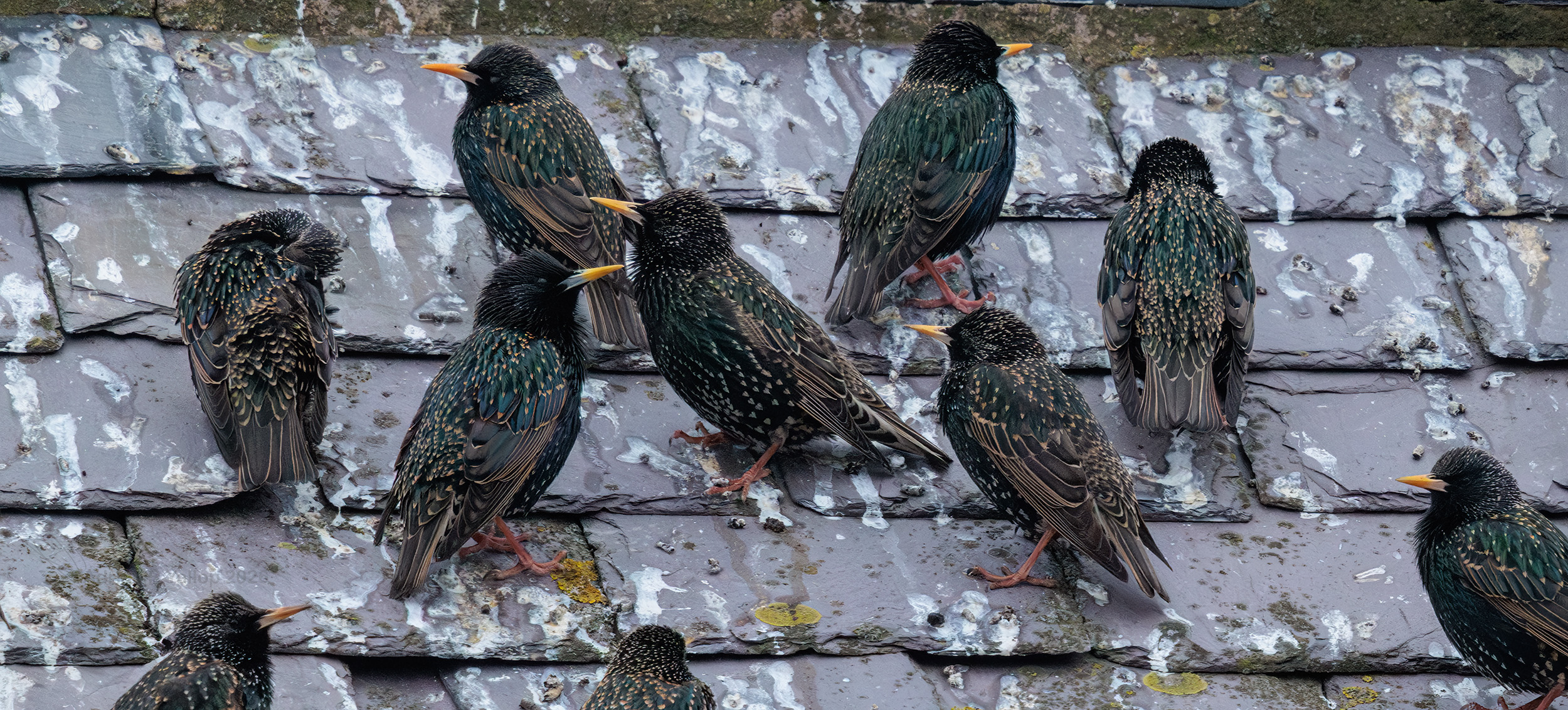
Sturna vulgaris Elie Fife
22/03/2026
Canon R5ii EF 500mm x1.4 f7 1/2049th ISO2500
best foot forward
I think starlings are often thought to be dark, dull, perhaps even black, despite that lovely speckling. But is that just a result of our usual weather? In direct sun they truly shine with iridescent colours. Sure not as immediately spectacular as, say, a Superb starling, but an understated elegance.
It is a sunny day, there are a few starlings in the field, what an excellent chance to try capture that iridescence. Umm, well that’s certainly an idea. Of course it can only be seen from certain narrow angles. And the birds keep walking and jumping around don't they. Well I spend rather more time than I imagined I might have to, moving sideways, up and down the track, moving the camera view from bird to bird to bird. I must look a bit like a confused crab. Well this one shows their prettiness despite how they tried to conceal it.
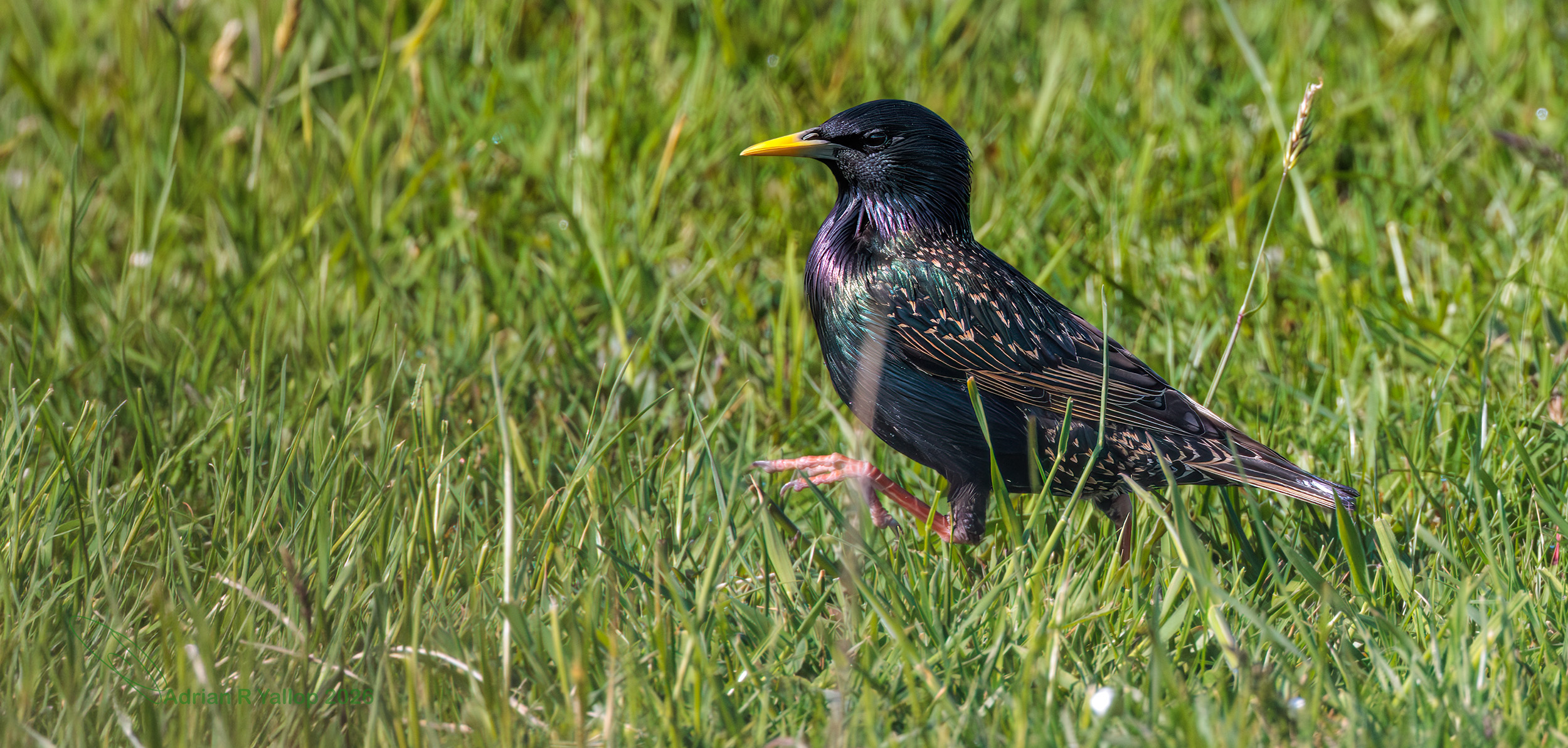
Sturna vulgaris Strathnairn
25/05/2023
Canon R5 RF 100-500mm x1.4 f11 1/4098th ISO4000
jewel in the grass
at last s/he stops for a moment to look at something, it gives me a moment to jig sideways and get a better view, perhaps I only need one, but I like starlings, think I said that.
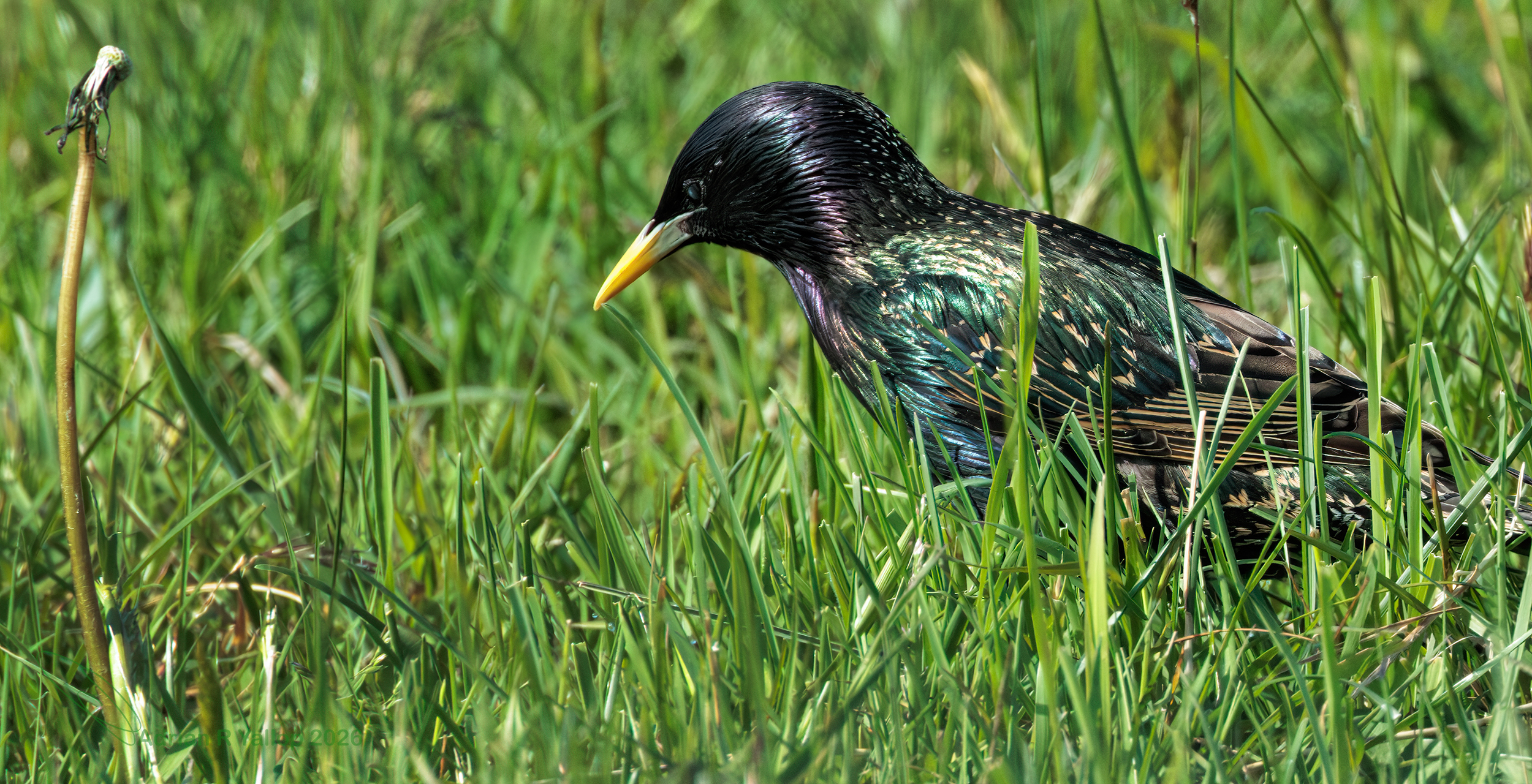
Sturna vulgaris Strathnairn 25/05/2023
Canon R5 RF 100-500mm x1.4 f11 1/4098th ISO4000
Jackdaw Sturnus vulgaris
Variously known as Jack; Daw; Caddaw; Caddy/Caddy (from Norfolk, so clearly correct); Cardaw. In Scotland was called Kae; Ka or Ka wattie and in Holland as Kauw. As with many birds in the UK it is associated with rain (yes it rains a lot here, so good chances of that one working out). In Wells it was said " whenever a jackdaw has been seen on one of the vanes of the cathedral tower we shall have rain within twenty-four hours", and in Norwich there is a rhyme
" When three daws are seen on St. Peters vane together,
Then we're sure to have bad weather "
Apparently, seeing just one alone was back luck, and a flight of Jackdaws down the chimney was thought to portend death of one of the inmates of the house (and a sh..load of soot on the floor I imagine). They do have something of a reputation when it comes to nesting on top of chimneys, I assume they just enjoy the warmth, certainly I've watched local birds competing noisily to perch on the rim of an 'active' chimney-pot.
Well, all that aside they are an intelligent, active, gregarious, and noisy species, always seeming to have something to say to each other, perhaps it's "why do you always stink of bloody smoke?" I really like them, a lot. We have a large roost (colony) in trees close by, and I find their constant chatting cheerful beyond measure. The collective noun for a group of Jackdaws is, apparently, a 'clattering', I'd prefer a 'chattering', but I don't get to decide such things do I, and that, to be frank, is begining to piss me off.
'ol blue eyes'
ok, that isn't right really, because only the juveniles have blue eyes, they fade to white with age.
I could watch these active birds for hours, their upright stance when walking giving them an intelligent and confident 'air'. They can be hard to approach close tho' to get a nice picture, sitting quietly in the sun and waiting is the best way.
photographically this is a poor picture and it is really only here as a set up for the next one !

Coloeus monedula ♂ Strathnairn
01-03-24
Canon R5 RF100-500mm 1.4x (700mm) f9.93 1/1025th ISO1600
altogether prettier
an altogether prettier picture, I think, showing how the same bird, at almost the same place and time, can make a very different image. Firstly, the bird is simply at a different angle relative to the sun, allowing the silver-grey nape, typical of this species to show much more clearly. Secondly, but equally important, the poor bokeh and deeper depth of field of the small apertured RF100-500mm I was using then, that spoils the picture above, is mitigated here by using a low camera angle that exploits undulations in the surface of the heath to recreate the narrow focus zone typical of much wider aperture lenses. One day, I hope to cover such topics in more detail somewhere else on this site (when I can get around to making it I mean!)
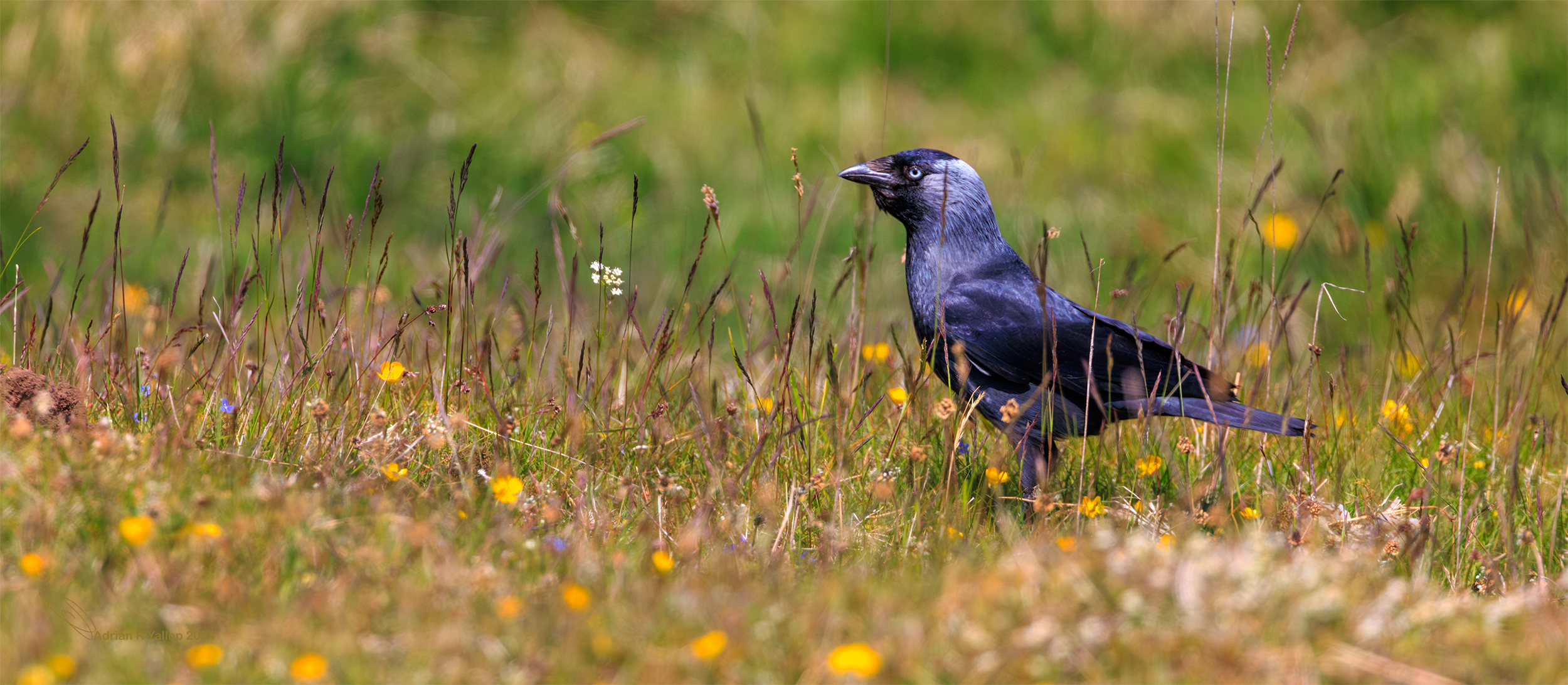
Coloeus monedula Strathnairn
01-03-24
Canon R5 RF100-500mm 1.4x f9.93 1/1025th ISO1600
chimneyophile
well yes any collection of Jackdaw pictures has to have one with a chimney! Is ‘chimneyophile’ a word? Well if it is, and it ought to be, it will be applied to this species. I have no idea what they did before we invented them. Stand around and look miserable I expect.
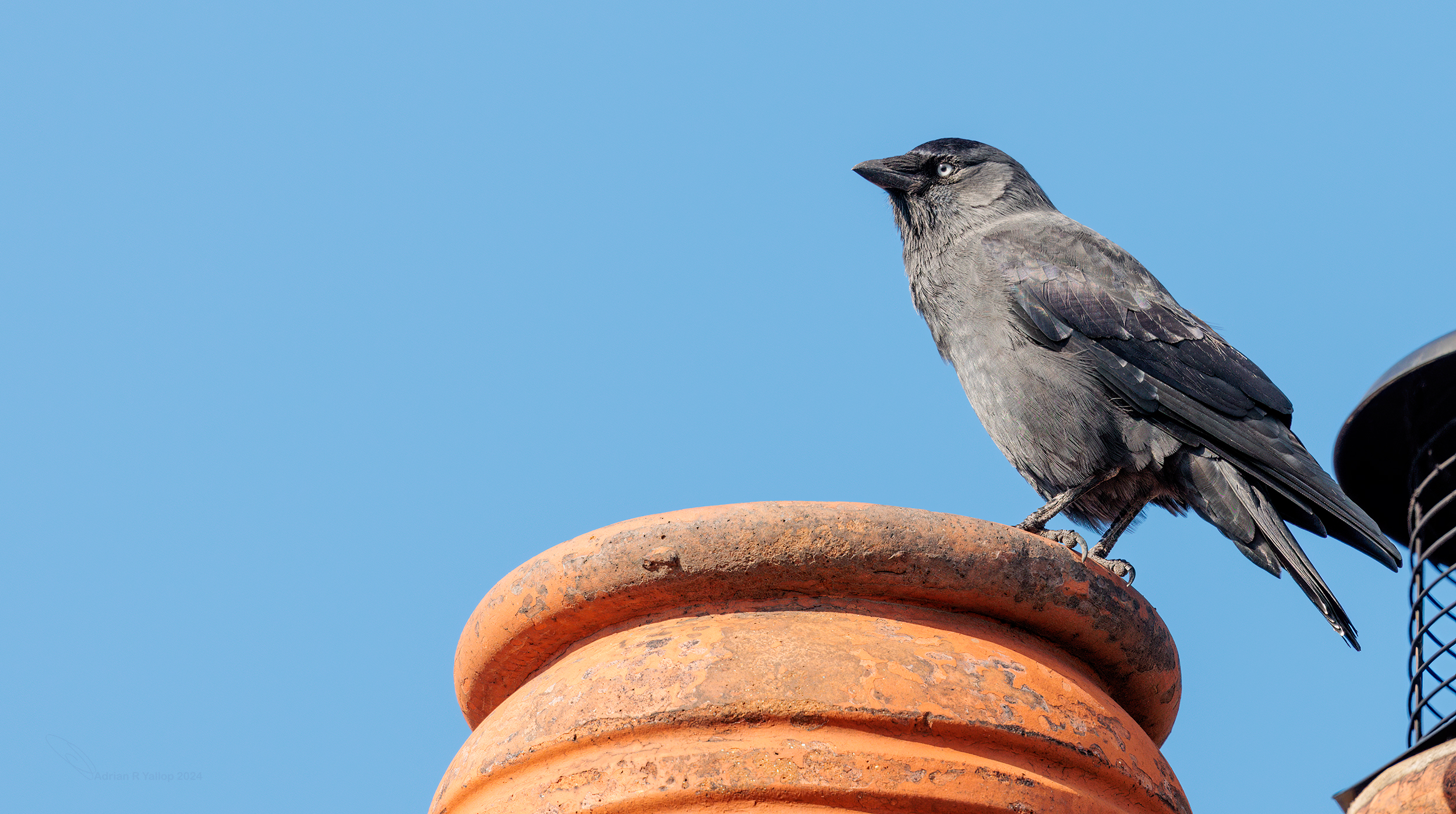
Coloeus monedula Inverness
24-09-25
Canon R5 EF500 1.4x f5.6 1/724th ISO40
Carrion crow Corvus corone
I am sure their ubiquity and lack of colour means most folk turn a blind eye these bold, sleek and intelligent birds. Sure they are less noisy and gregarious than Jackdaws and Rooks but I find it's still worth stopping for a few minutes to watch one or two patrolling around a field looking for food. Somehow you can see an intelligent purpose in their walk and poise, well I can, perhaps I'm odd.
As with its current name many of this bird's earlier names relate to its habit of scavenging the flesh of dead animals, hence: Car crow, Carner or Carener crow, Flesh crow, Midden craw and Gor, Ger and Ket crow. The Latin name for crow gave us Corbie crow, Corbie and Craw.
Black-nebb'd craw and Black neb unsurprisingly comes from its colour, with its call giving us Hoddy, Huddy craw, Dob and Bran.
As for rhymes and songs I have to prefer this one from Suffolk
" There was an old Crow
Sat upon a clod:
There's an end of my song
That's odd "
Funny buggers those East Anglians.
Swainson (1885) notes that superstitions regarding Carrion Crows always paint the bird in the worst and sinister way, representing death or night or winter. In Hungary it was called the 'bird of death', its cawing also portended evil and the sight of one to the left of the viewer was fraught with ill results. In German Switzerland a crow perching on the roof of a house in which lay a corpse was a sign that the soul was irrevocably lost while in Sussex it was said that its cry, thrice repeated was a sure token of death.
Well, that's all cheerful stuff, but I still like them!
a cold and frosty morn'
Sit.rep: December, -4o C, Stirling University campus, pre-dawn.
In search of a few duck to photograph in the early frosty light on a sharp cold morning I came across this rather dejected-looking Crow. I couldn't work out what he was doing, indeed I still don't know. He's nibbling at the frost, mebbe simply after some water perhaps, and everywhere is frozen. The light was too poor for a decent picture, but here it is anyway. And that really is frost on his back and wings.

Corvus corone Bridge of Allen
11-12-24
Canon R5 EF500mm f4 1/512th ISO6400
we all like to be beside the seaside ........
I've always been intrigued by seeing corvids on the coast, somehow they just look 'wrong'. Please don't ask me why, it's just a thing.
Can I presage this story with a single interesting little fact. Sand and saltwater utterly destroy cameras and lenses. So let's just say I get nervous even thinking about taking pictures down on the beach. Well it's a sunny sunny day and I have to confront this issue, so I decide to take a trip out to a quiet beach in search of a few seabirds.
The first bird I see is this sweet little chap, he's slowly promenading along the beach, looking cool, occasionally stopping to turn over a piece of algae, or inspect other odd 'bits', washed up by the tide. Key thing is he's slowly walking toward me. If ever there was an opportunity to stare my fears in the eye this is it. Well I lower my rucksack to the sand, lay the camera on top, then I join them, laying prostrate in wet, wet sand, lovely.
I follow him through the viewfinder as he draws closer, he seems totally oblivious of me, and very relaxed. He's at the seaside, who doesn't relax at the seaside? As he walks past I snap a few, light isn't prefect but if I waited for perfect light I'd never push the button.
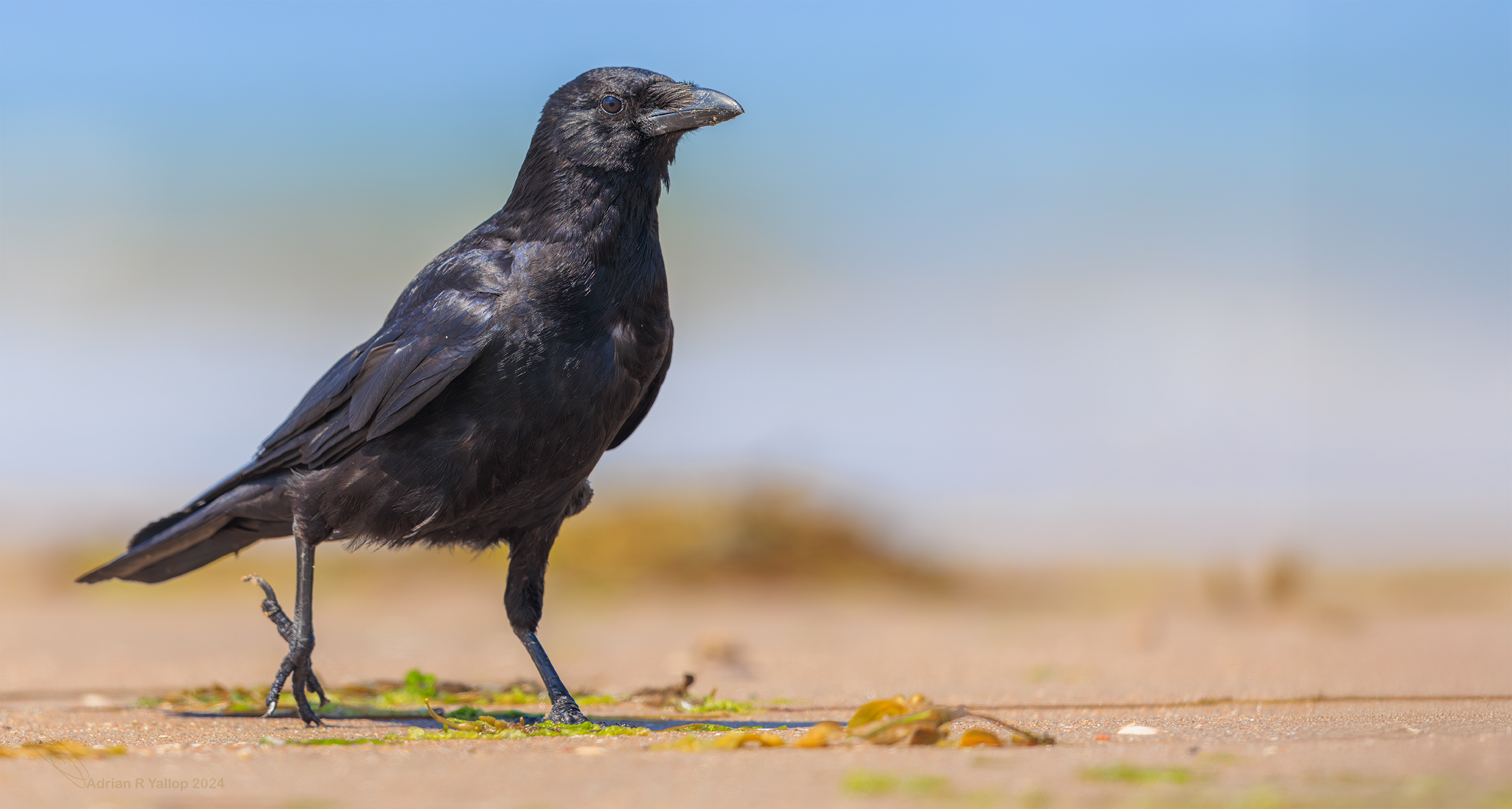
Corvus corone >Carse of Delnies
20-06-25
Canon R5 RF500mm f4 1/2049th ISO500
beside the seaside ........
II
Is that it? Well, not quite. You see as I watched him walking along the wet sand toward me, recently exposed by the retreating tide, I noticed a couple of people also walking in my direction, but higher up the beach. They were too far away to disturb my friendly corvid and I thought no more about them for a bit. After a while I began to hear their voices, getting louder as time passed . . . . . .
. . . . but then they stopped about 50m away, and stood juststaring at me. I had a bird to photograph so I ignored them. After a few minutes tho' I was all done, I rolled over and sat up, they were still there, looking at me. As I moved they turned and started walking away.
So why were they staring at me? Were they were genuinely interested in a man photographing a bird, possibly, or perhaps they wanted to see me cry after destroying thousands of pounds worth of gear, also possible I guess. Well, as I replayed their actions in my mind, I became increasingly convinced they actually thought I was a corpse, a victim of drowning, just washed-up and left behind by the retreating tide. After-all I had been laying there, absolutely motionless, in the recently exposed and still wet sand, amongst odd bits of seaweed for over 20 mins, long before they had come down to the beach. All they had seen was someone laying half on a rucksack at the water's edge, for a long time. The things I do. Whoever you are, if I alarmed you, I apologise.
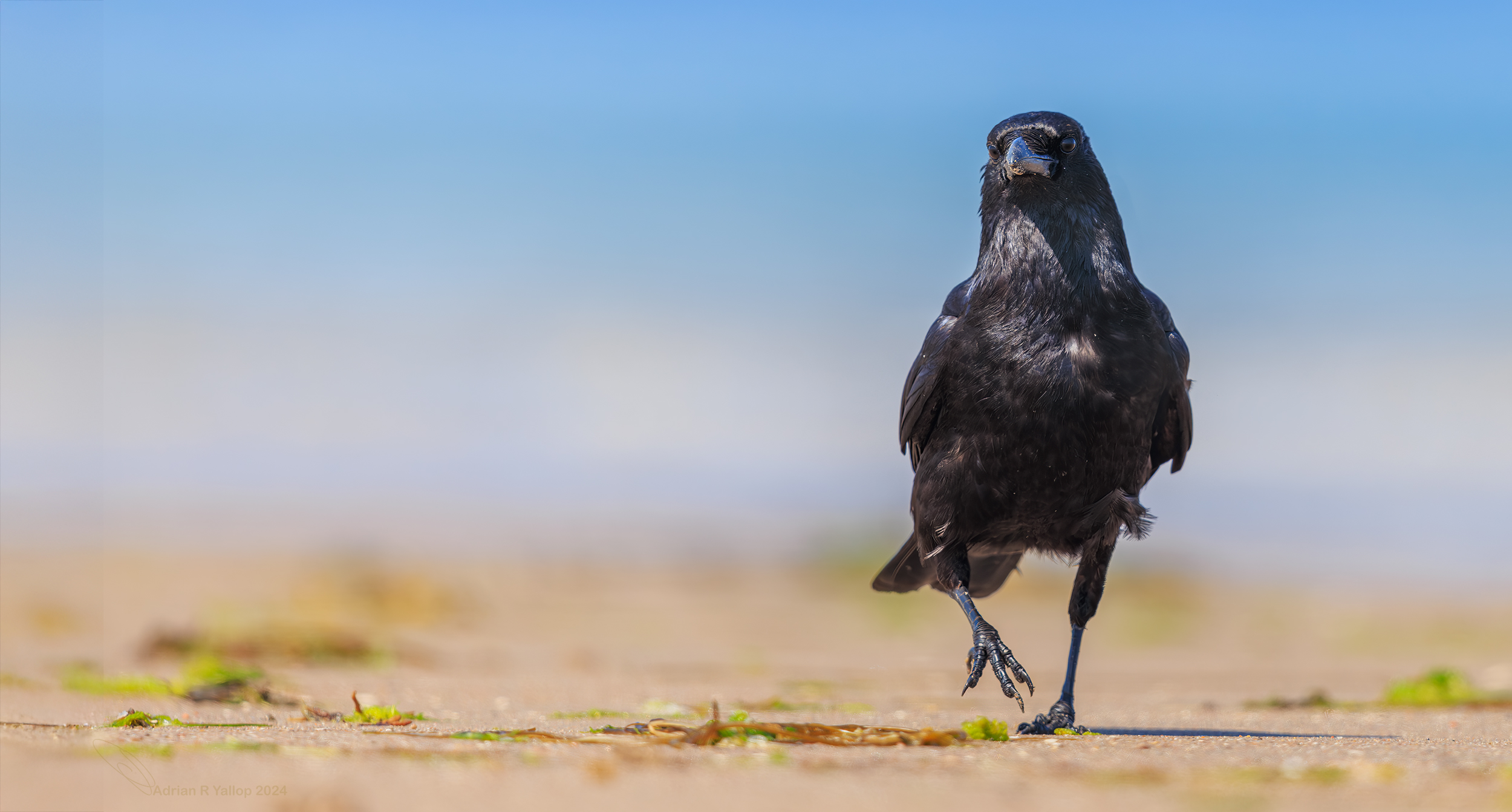
Corvus corone Carse of Delnies
20-06-25
Canon R5 RF500mm f4 1/2049th ISO500
Hooded crow Corvus cornix
Everything I said about the crow, but now with another colour! Has been called Hoodie (still is by me) together with Hoddie, Dun, Grey-backed and Grey crow: all obviously from its plumage. Local names included: Royston crow and Royston cick, Kentish crow; Market Jew crow, Scremerston crow, Corbie, Craa, Scald crow, Praheen cark, Bunting crow and, the obvious winner, Cawdy mawdy.
As it was supposed that numbers of hooded crows found on the English coast in winter came from abroad, they have also been given the name Norway crow, Danish crow and Harry Dutchmen. In Norfolk they were known as Northern crows, heck 'The North' was more than foreign enough those folk.
The only 'song' that Swainson (1885) notes is from Moray. Before fully and truly enjoying this ditty we need to know 1: Gule is a local name for a voracious weed that reduced corn crops (prob. Corn marigold) 2: Gordon's were (are) a Scottish clan known for destructive raids. Right, now we are up to date with all that, I give you:
" The gule, the Gordon and the Hoddie craw
are the three warst things things that Moray ever saw "
I didn't say it was any good did I.
Absent from much of the UK Hooded Crows are generally distributed up at the northern end. Locally here in Strathnairn Hoodies appear to have become more frequent in the past few years. That's all for the good as far as I'm concerned, I like corvids, and another one is always welcome in my books.
Is this the time we have to bring up the separate species issue, again? Why do we seem to have do this conversation so often with birds, and not much else. Well birders just love a ‘new’ species. A few yrs back, these were a race, now they’re supposedly a separate species. Does evolution work this fast you may wonder. Keep wondering! ‘Ornithologists’ also love setting themselves up as an ‘authority’ and laying down the law. You would(n’t) be surprised how many ‘official’ groups, unions etc. there are worldwide. Now all I’m going to say is this, they interbreed and produce fertile offspring. That’s the scientific definition of a species right there. End of.
toupée
?
This morning is blue skies, low bright sun, but that north wind is biting, and very lazy. I am wandering along the south side of Beauly Firth looking for any waders that might be about. Instead the call of a crow gets my attention. Up ahead a couple of crows, one hooded, one carrion are exploring the shores edge.
I watch this for a while, I do hope these two aren’t in love, it will upset some ‘ornithologists’ if they are (see above). I creep closer, then closer, watching their behaviour as I go. The hoodie is turning over stones and bits of bladderwrack (Fucus vesiculosus), I’m not sure what he’s looking for, but then he starts a tuggin’ and a pullin’ and, like a magician pulling a rabbit from a hat he produces what looks like a toupe. Well I hope it’s a toupe and not a head! Either way it’s worth a picture.
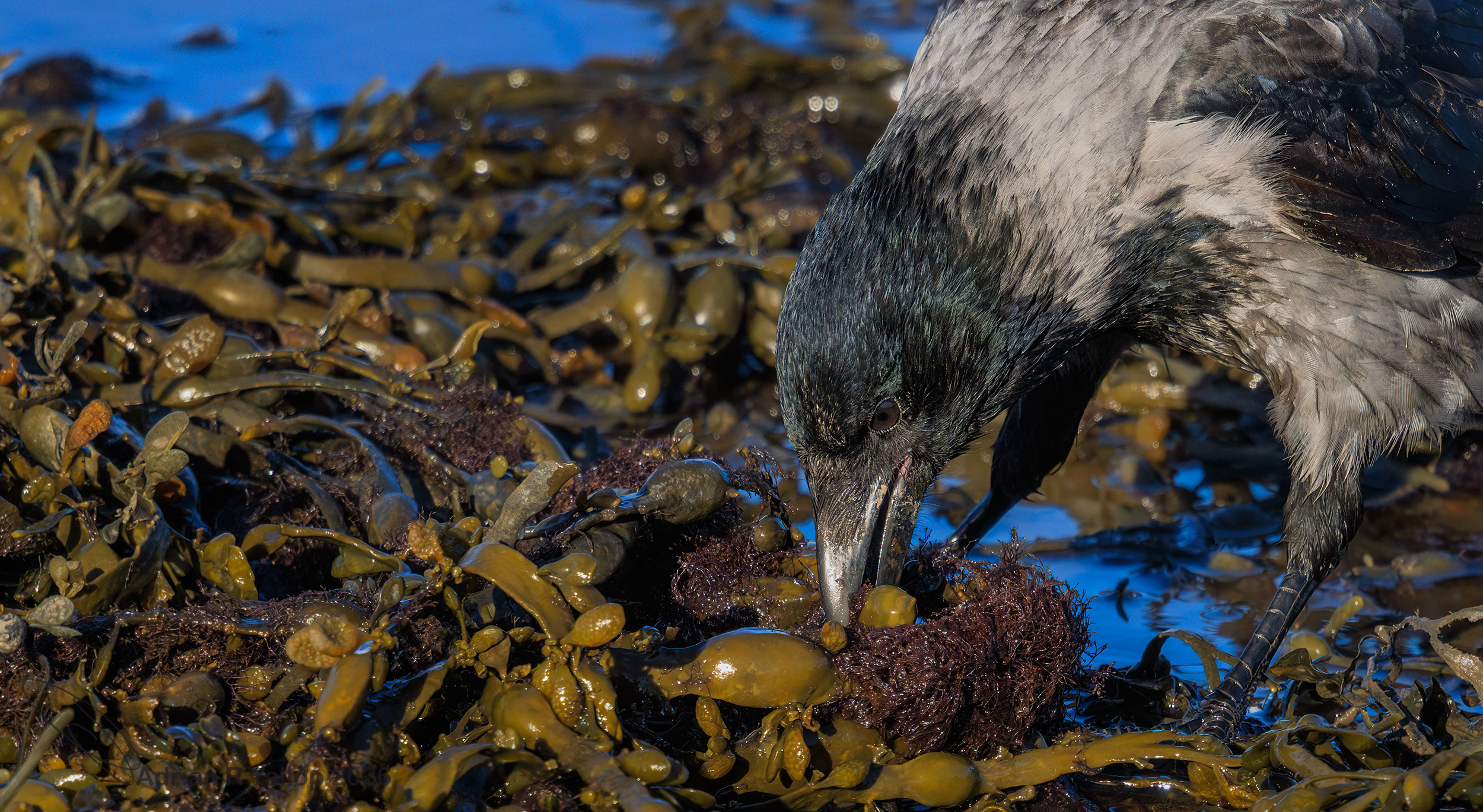
Corvus cornix Inverness
10-02-26
Canon R5ii EF500mm x1.4 1/3156th ISO3200
hoodie, striding out
. . . after snapping those Tuftie chicks (cute) in Muirtown basin on the northern end of the Caledonian canal, I walk over the railway line out along the last half km or so of embankment to the final loch, cross it and back along the other side. Tis’ a bit blowy out here, taking some heat from the sun. I am not alone here regrettably, there are numerous dogs and their walkers. Still, needs must.
My interest in this place is the possibility for the odd wader on the shore, gull etc. Today tho’ there is a good a mix of corvids, mainly carrion crow, some of the their hooded brethren, and the odd jackdaw too, the latter perhaps surprising as there are no chimneys’ about. They’re all patrolling the grass of the embankment, seeking insects or discarded sandwich or crisp. I have an opportunity for a some pictures I think. However, as I slowly close with the nearest birds I notice something, they’re more wary than I might have thought for urban birds. As this is obviously a dog walk route I suspect being chased by an occasional fat slobbering lab keeps them alert. They have learned to simply hop en masse across to the other side of the canal and ‘flip the bird’ at their pursuers so to speak. Birds do actually have a middle digit, I’m not saying it evolved just for this purpose, that would be so sweet tho’ wouldn’t it. Of course as I try to approach them they are happy to treat me the same.
In most cases my normal approach here would be too lay down, have a snooze, and wait for them to come to me. Did I mention the dogs, yeah well I’m sure aint going to get down there: I have a momentary flash-forward to a few hours ahead “can I please have a lift home in your nice new shiny leather-clad ranger rover darling” I will ask this afternoon “why you do smell of dog-shit ? Oh look you are covered in it, fuck off and walk”. So It’s down to creeping as slowly and least menacingly as I can.
time passes - : eventually I am amongst a little group. This chap watches me cautiously as he strides across the path. I thank him for his forbearance.
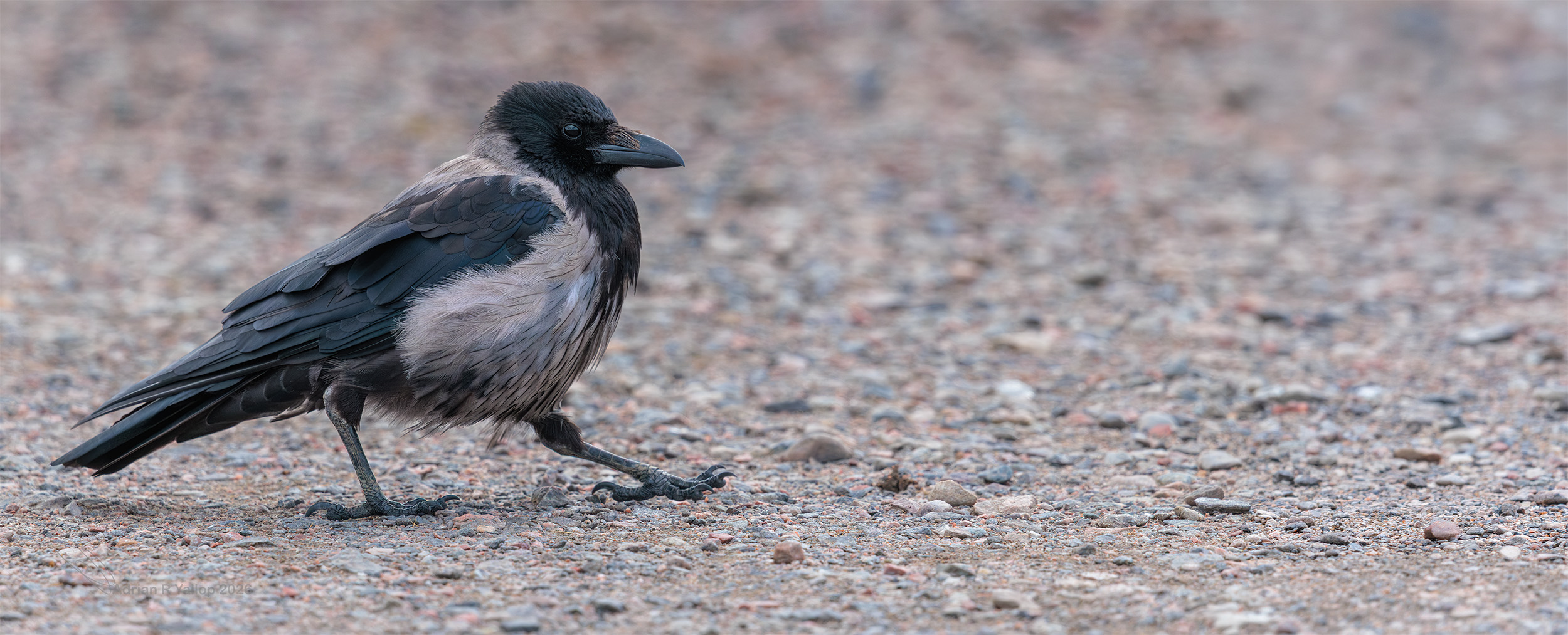
Corvus cornix ♂ Inverness
27/07/2026
Canon R5ii EF500mm x1.4 f6.4 1/2049th ISO1000
hoodie, looking, with distain
As I look about, standing still, and panning the camera very slowly, this chap appears in the viewfinder. Peering at me over his shoulder, with his head sunk into his shoulders. he makes me think of royalty, dressed in dark robes with an ermine stole over his shoulders. I bow, ‘slowly’ and ask “may I take your picture my lord”. He nods graciously. Snap. “Right, move along there my good man” he mutters, making a dismissive gesture. I instinctively did what one of my class does when instructed to do something by his superiors, I flipped him the bird.
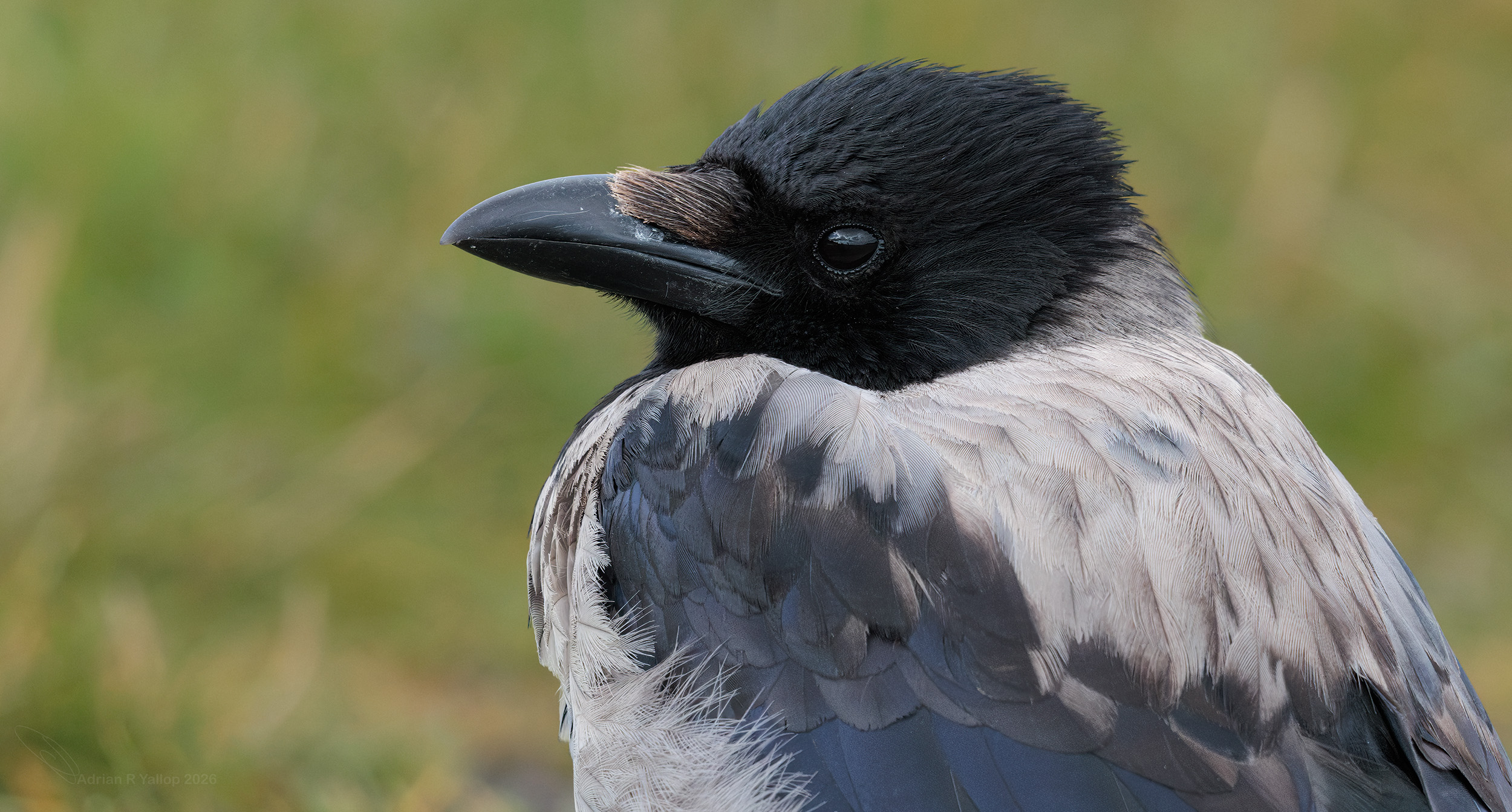
Corvus cornix ♂ Inverness
27/07/2026
Canon R5ii EF500mm x1.4 f6.4 1/2049th ISO2000
Magpie Pica pica
It is easy to put two and two together and work out that the ‘pie’ half of this birds name derives from piebald, ie black and white. But it’s the other way around, ‘piebald’ mostly likely arises from the magpie. This would make sense I suppose, how many other obvious black and white things were around to be seen by European country folk during the 15th to 17th centuries, or earlier? I mean they had no zebra crossings to refer to (or even, for that matter, zebras!).
‘Pie’ itself is conjectured to mean ‘pointed’, and can be traced to the Proto-Indo-European language. Naturally, Proto-Indo-European is usually abbreviated to, yes you worked it out, PIE. Now, I’m getting confused too, so let’s move on. The ‘Mag’ part is derived from the contraction ‘Margot’ (Marguerite) which was used as a generic name for a woman in general, much as John is often used for men. The next bit will get me in trouble I am sure, but in for a penny, in for a pound! It is suggested (not by me, no way, no sir) that the sounds made by a group of Magpies resembles the endless chattering of woman, hence we got Mag Pie. As I honestly never realised that ladies might be capable of nattering on endlessly at every opportunity, this whole notion came as something of a complete surprise to me. Let’s move on, keep moving I always say.
Aka: Pie, Piet (Westmoreland) and Pianate or Pyenate (West Riding). We also have Mag or Madge, Marget, Margaret, Miggy (North country) Nanpie (Craven) Ninut (Notts) Pye Mag (NW lancs: I suspect they’re just trying to be different), also Hagister (Kent). I feel the nicest name award ought to go to Norfolk for ‘Chatterpie’. They’ve captured the essence there without invoking the danger of suggesting that ladies like a good natter. Well done Norfolk.
It’s hardly seems worth mentioning the fact that Magpies, like so many birds, were claimed weather prognosticators. I can believe that, without the endless blathering on about weather on TV, radio and Interweb, folks of earlier times might have had to look out the window to see what the birds were up to. In the south of France, for example, it was believed that if Magpies were seen building their nest on the highest point of a tree, a calm season could be expected. Now that’s probably going to be as accurate as anything the tax-funded Met Office has ever produced. This gave rise to the proverb “
Gran bèn te mancara pas, Se' l'agasso a nisat bas.” which, for non-Francophiles, google helpfully translates as: “
Great ass you won't miss it,
If the agasso has nested low”. I prefer to believe that should read ‘great arse’, but that’s just me.
Magpie folklore is seemingly endless. Like it’s darker cousins it was considered a bird of ill-omen with associations to the Devil himself. In Germany, for example, and up into Scandinavia, it was believed witches could adopt their shape, or use them as a stead. Presumably when their broomsticks were in for a service. In Sweden it was said that when sorcerers went to Blakulla on Walpurgis Night they transformed into Magpies: Hence: “
De hava varet till Blakulla, och hjelpt hin onde föra in sitt hö, da fjædrarna af oket blivit nötte af deras halsar” *. This ‘explains’ the loss of the magpies neck feathers in Aug/Sept. Unfortunately, I am not certain if ‘Blakulla’ was a pub, or not, but I certainly like to think so. Similar menacing stories abound from across Europe, except in Norway, for some reason. I cannot close, although I wouldn’t mind doing to, without acknowledging the well-known rhyme.
“One is sorrow, two is mirth ,
Three a wedding, four a birth,
Five heaven, six hell ,
Seven the deil's ain sell. ”
Now I bet that is different from the version you learned. All sayings, of course, were originally transmitted by word of mouth. And your mind wanders as you travel from village to village, or you fall in a dung-heap, maybe you’re attacked by squirrels, or something similar, and you forget the a line or so. Still just make up a new one as you wander along, they’ll never know. Also of course the above version is missing three numbers, was this a particularly bad journey? Anyway, we have, amongst others:
“
Three a berrin', four a wedding” (Northants)
“
Five for rich, six for poor,
“
Seven for a witch, I can tell you no more! ” (Lancs. Obviously an honest traveller!)
“
Eight for heaven, nine for hell”
“
And ten for the devil's ain sel '."
This is all getting way too long, but before I stop I must add the following to avoid upsetting a good friend. You should always greet a single Magpie who crosses your path with a “Good morning Magpie, how is your wife”. This is probably to ward off the bad luck from seeing a single Magpie. Of course you could follow the Shropshire way, take off your hat, spit at the bird and say “Devil, Devil, I defy thee”.
There isn’t space here for all the folklore around Magpies and I’ve excluded so much great stuff. So here’s a link
⇢ “here” ⇠ if you want to delve deeper.
n.b. connects to the external site: Internet Archive.
* The magpies have gone to the Blakulla and have helped the devil to carry his hay, so their feathers have been rubbed off by the yoke.
in the green
I’ve mentioned the faecal minefield surrounding Musselburgh Lagoons before (see Little Grebe) but once the hop, skip, jump was over I found this cheerful chap waiting for me and it all became worthwhile. How do I know he was happy, well he was chatting away to his missus a few metres away. I think they were discussing whether it was worth flying over to the nearby IKEA for new nesting material, or whether some twigs and leaves would do.
I politely said good morning to him, as one must, although I didn’t ask after his wife as I could see she was fine. At ground level I get a lovely view as he hops about so I ask him if he would mind posing. “of course not”, he replied “I get a lot of people asking that”. Here’s his picture.
Photographically, while the sun-angle and light could have been nicer, I still think the short grass, the lovely bokeh of the 500 f4 and the colours make this pretty enough for inclusion. And it’s my website after-all.
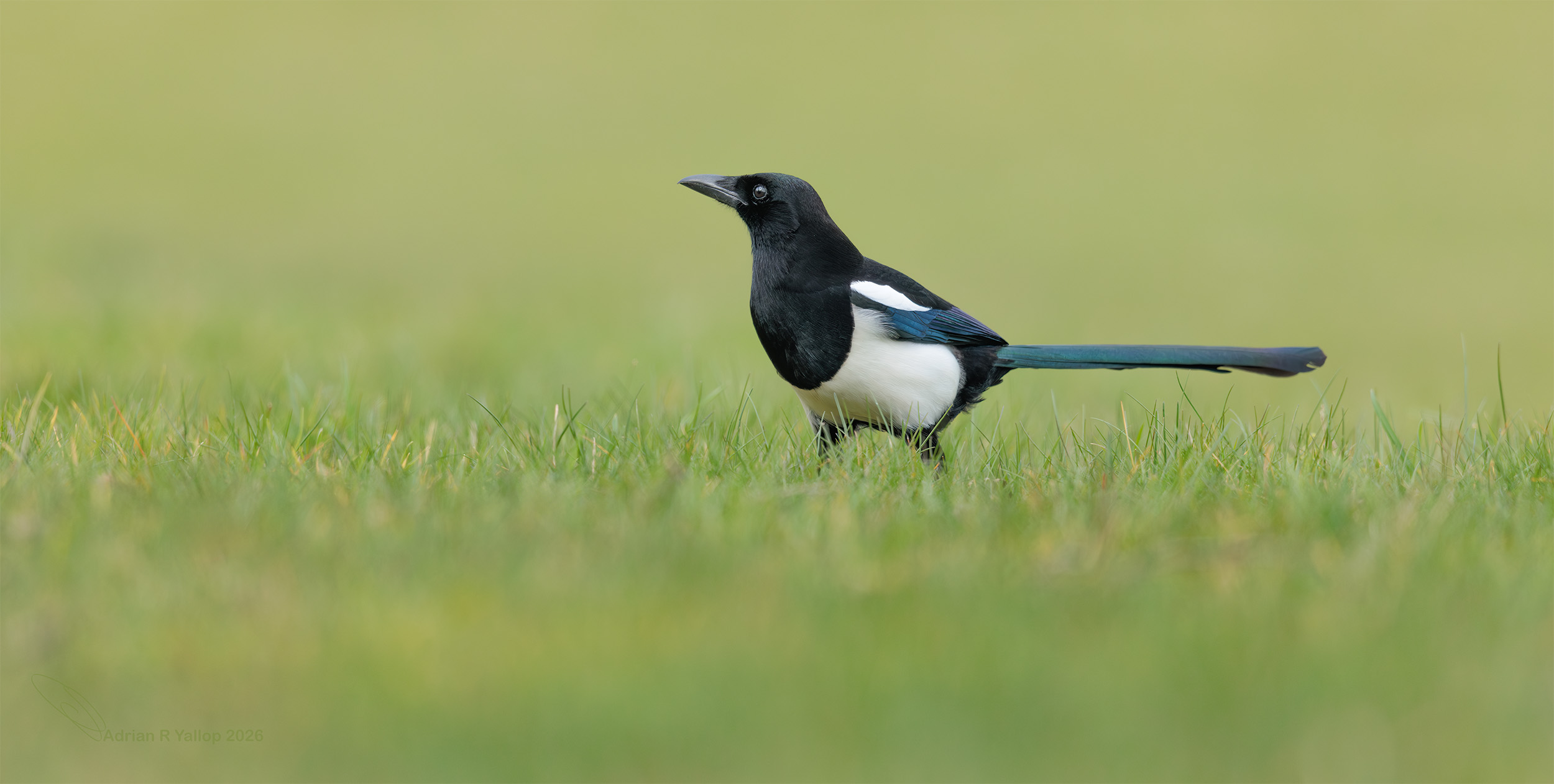
Pica pica Musselburgh Lagoons
23-03-26
Canon R5 RF500mm 1.4x f5.6 1/1580th ISO100
wet, wet, wet
I’m in the North East of England, in the realm of the Geordies. And it is raining, hard. I’m at Saltholme, an RSPB reserve set amongst the industrial past of Teeside. Not many birds to be seen, an odd mallard, coot etc. splash around in front of a multi-million pound visitor centre. Going in to get out of the rain, I notice that owing to the design of the place it is impossible to get any pictures, or even see, birds directly as there are no openings, just glass, double glazed. Somewhat of a disappointment. I leave and choose the longest trail to wander along, in the rain.
What do I find? Not a great lot. But as I continue to splash my way around, hood up, head down, I hear that delightful chatter of a maggy, perking up I see him/her fly into a small tree, and then out again. I peer through the rain, where did he go? There he is, perched on a post. I have no nice pictures of the species so now is a potential chance. Letting go of the bins I bring the camera up - snap- a few quick record shots but before I settle down and begin think through the images I want, he’s off again. As my head falls rain runs off my hood into my face. Lovely . . . . just lovely.
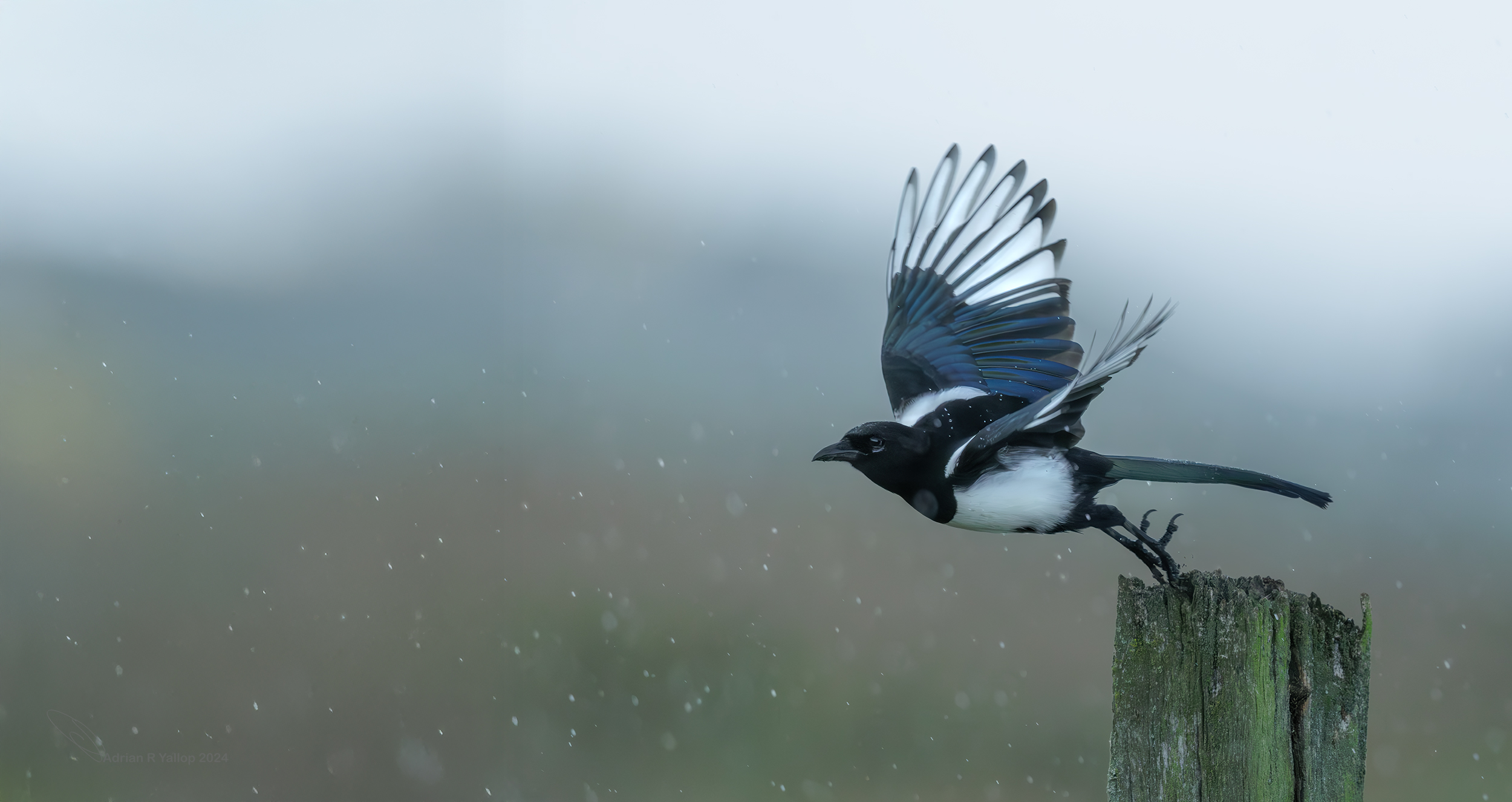
Pica pica Saltholme, Billingham
19-10-25
Canon R5 RF500mm 1.4x f5.6 1/2049th ISO16000
wetter
? you'd better believe it
He settles a few dozen metres from me, not sure what he’s after, food I guess. I stand and watch him. He looks wet, the vegetation is wet, the water is wet. And, in the nature of things, the bird photographer is bloody wet too.
The rain falls heavier still, but as he hops about I take a few more. They aren’t going to be great, the light, the contrast, will not help me get much out of his this. But I'm here, and I've been dragging a heavy camera around in the driving rain for the past hour or so and, let's be fair, he’s having a pretty miserable wet day of it as well, he deserves a couple of pictures here. That, right there, ladies and gentlemen, is how I manage to sneak ‘pretty’ in.
Another load of water falls from a branch hitting me squarely in the face, and I have a sudden epiphany, it is such a startlingly bright flash of insight I almost hear celestial trumpets: ‘Fuck this for a game of smarties’ it went, ‘there is a warm dry cafe in the visitor centre only a kilometre or so away, and the lady there had some exceedingly nice fresh apple and cinnamon muffins on display’. So why on earth was I out here? Go feet, wet feet. Splash bloody splash.
Those muffins were indeed excellent, 10 out of 10.
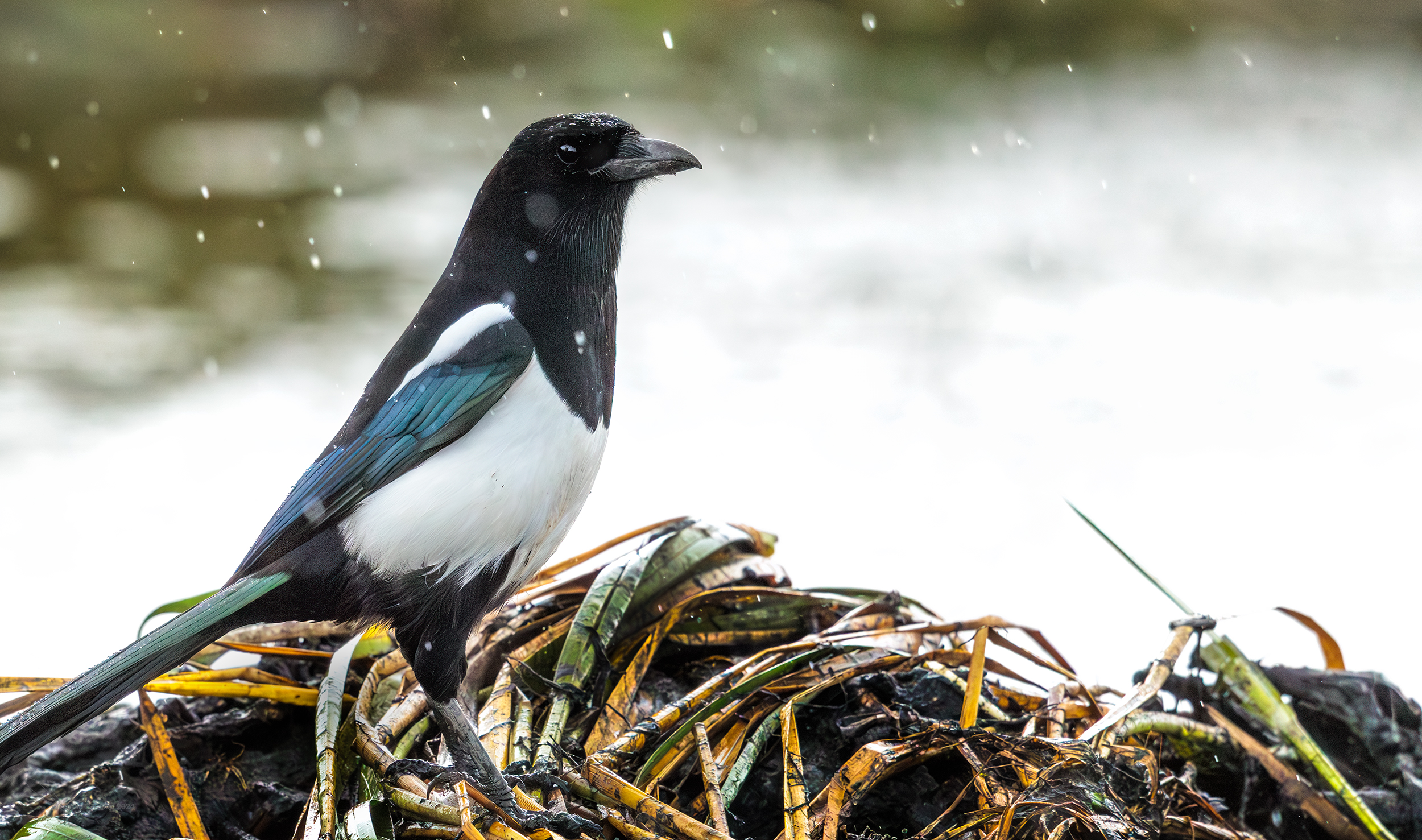
Pica pica Saltholme, Billingham
19-10-25
Canon R5 RF500mm 1.4x f5.6 1/2049th ISO5000
paying respects
Many people, perhaps most, might see cemeteries as sad, gloomy, even dead, places. I certainly don’t. Ecologically they are the living hearts of most urban areas, containing more wildlife than the rest put together. When I was between perhaps 8 and 12 years old I often used to play truant in an enormous old cemetery conveniently located just off a direct route from home to school! I can admit this now as I am fairly certain the statue of limitations for truancy should have kicked-in by now. Well I hope so, I’m too old for detention. I would spend my time in that cemetry sitting on a bench, just pondering, or just wandering, though the trees, old graves, mouldering monuments, listening to the birds and the peace. Idyllic tranquillity.
I always visit one whenever a chance arises. It is amazing how rapidly the clamour, bustle, smell, and overall unpleasantness of urban and commercial life, fade as you pass through the gates of a cemetery. A few metres in and it’s a different, quieter, altogether more sane world.
I have walked into Darlington West, there are some fine old trees in here and bits of almost wilderness. Lovely. This place hasn’t been ‘cleaned-up’ excessively, there are patches of mown grass for sure but they’re not excessive. Good. Far too many are shorn to death, if you’ll excuse the phrase. Cemeteries should be places of memory, tranquillity, not sterility.
As I watch, and photograph, a squirrel (grey) moving between some trees, grubbing here and there, my attention drawn by a distinct chatter. I leave him to his endeavours and soon track-down a pair of Magpies hopping about. We play an innocent game of hide and seek amongst the tombstones, for some time, without me getting a shot. I am scared of disturbing them and seeing them fly, so try to be particularly cautious as I approach the source of the chattering.
Then. as I lean sideways, to peer round yet another gravestone I see his chap has stopped and taking time to quietly pay respects. I slowly step sideways. Snap, Then I feel guilty that I might be intruding on his grief. I turn away in shame and retreat.
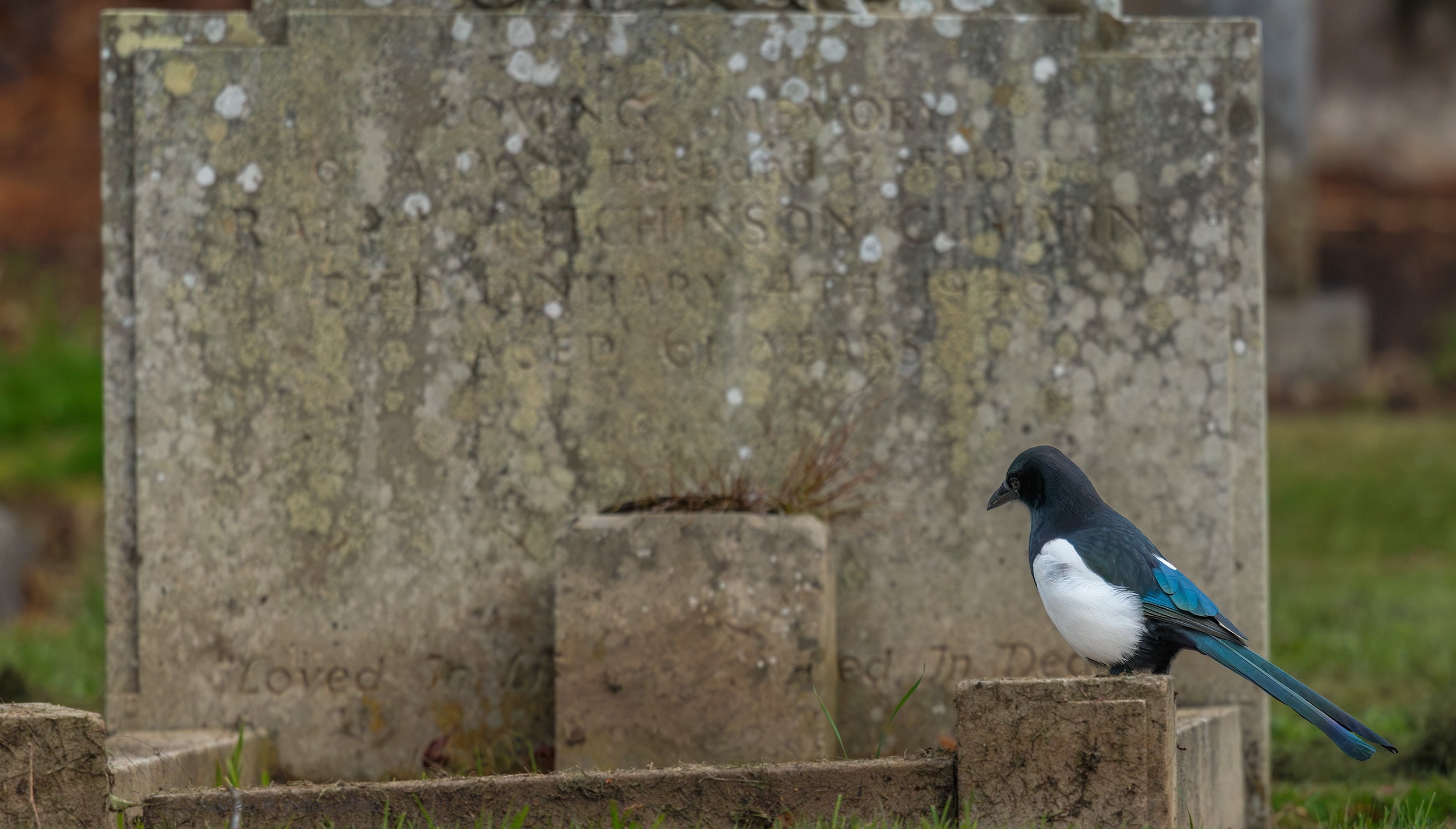
Pica pica Darlington West Cemetery
22-10-25
Canon R5 RF500mm 1.4x f5.6 1/1328th ISO2500
Iberian Magpie Cyanopica cooki
Currently I can find not literature on either the vernacular names or mythology of Iberian birds so, regrettably, cannot regale (bore) you with interesting facts and bon mots on the Iberian magpie. If such things exist I have not found them. I still look, and if I find them you will be the first to know.
So without further ado, here's a picture!
Iberian breakfast
?
Now I have to admit something I am not proud of: I rarely sit out on a balcony and have breakfast before sunrise. For some reason the scottish highland weather isn't often conducive to such things, and yeah I don't have a balcony. Excuses, excuses.
But in southern Portugal apparently you can do this sort of thing, in November too! Coffee to the sounds of birds waking up. Excellent.
A small group of Iberian magpies were amongst these, I confess it was a while (and coffee - that Dão was very nice last night, all of it! ) before I thought to get the camera. When I did, of course they didn't make it easy, more heard than seen, perching behind power lines, bushes, or miles away. The best I could do was against the ever-brightening sky and it's not great. Did I mention the wine?
Still right now it's the only pretty Corvid I have so it will remain till I get back to the Iberian peninsula.
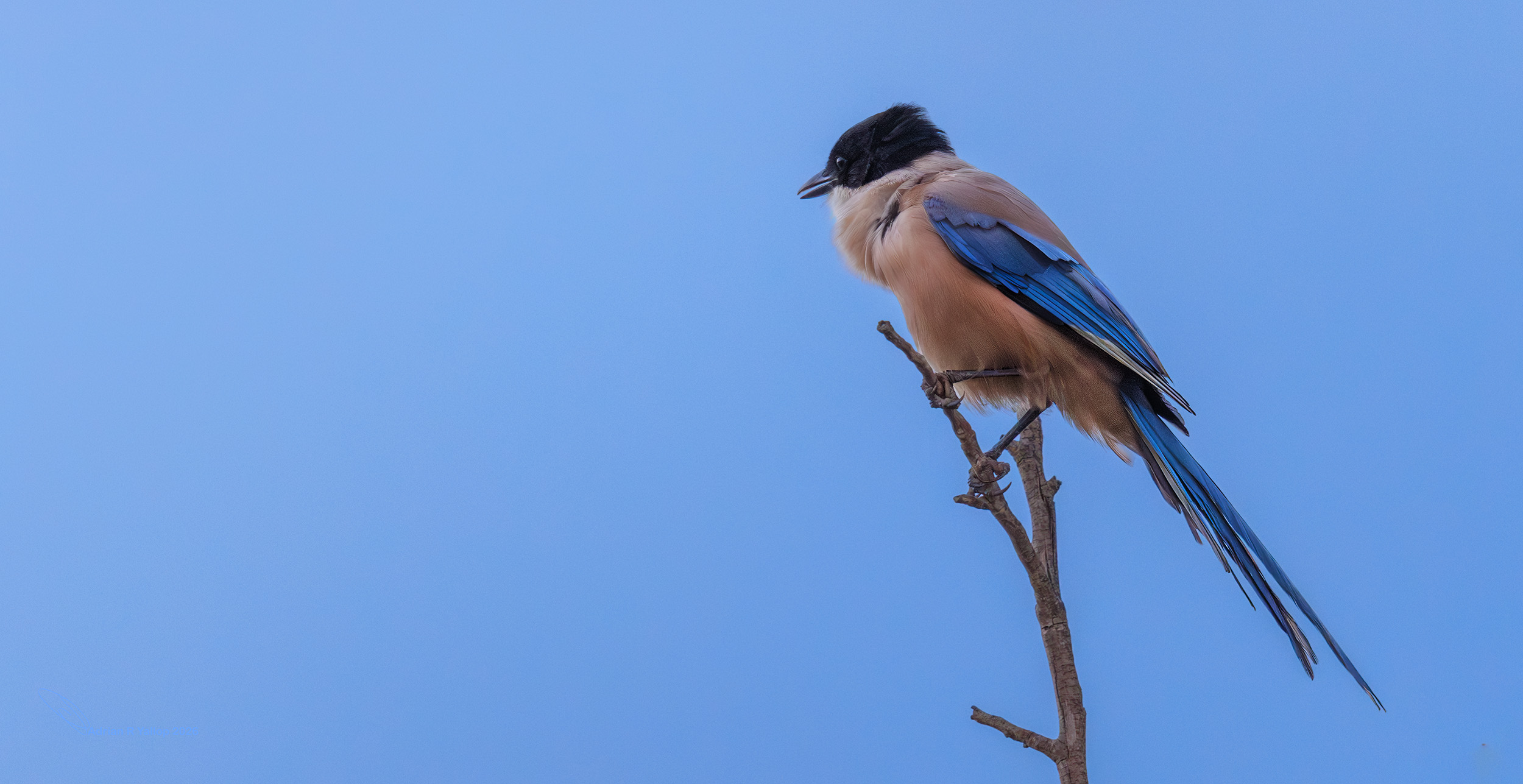
Cyanopica cooki ♂ nr. Fusetta Algarve
25-10-24
Canon R5 EF500mm f4 1/3165th ISO000
